
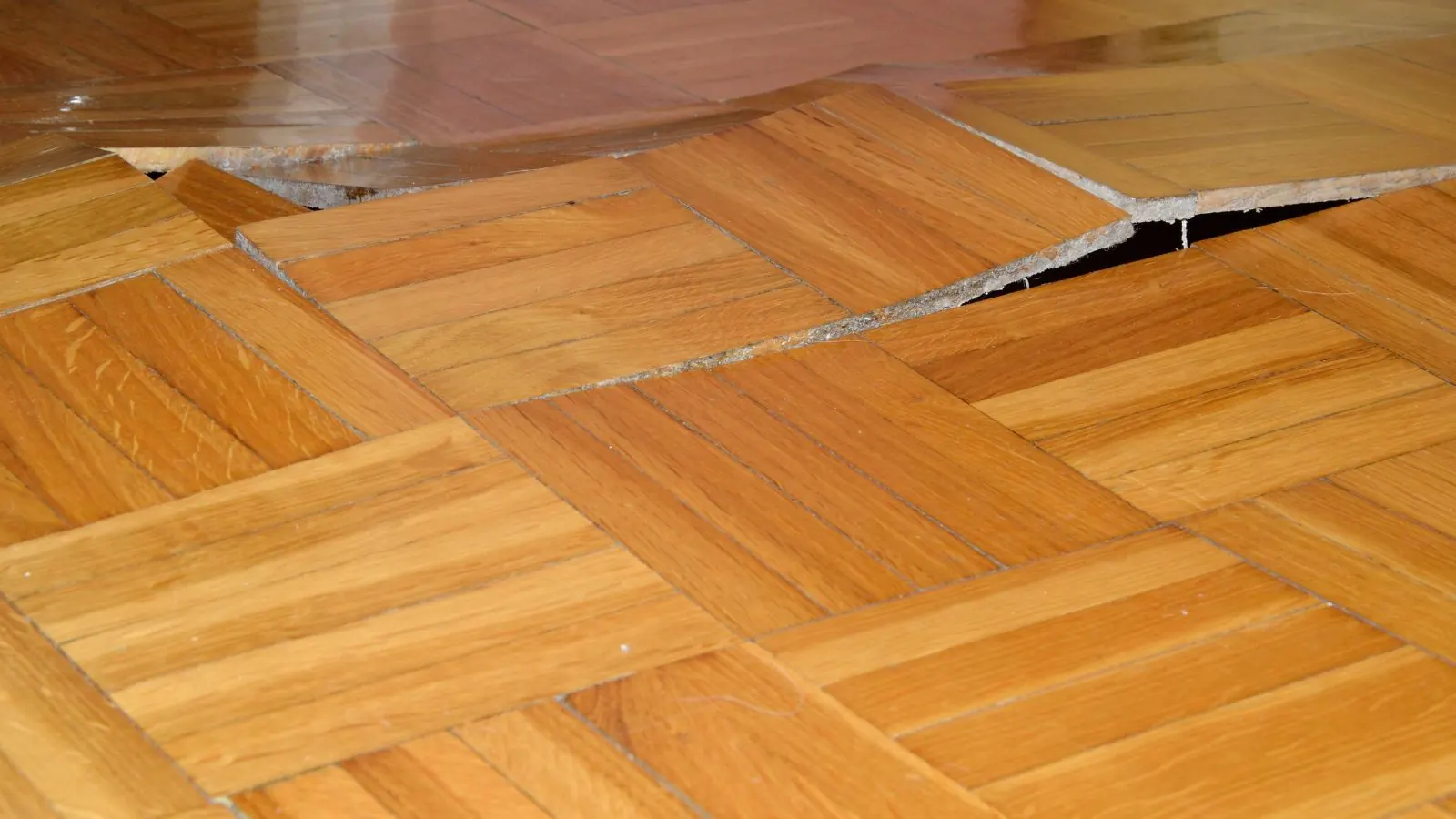
What water does to a wood floor
Wood takes up moisture through its edges and underside faster than through the finish. Each wet board swells and pushes against its neighbors, and the floor shows the damage in ways that depend on how the water arrived.
That swelling may take days to show. A floor that looks flat after a spill can cup a week later as the bottom stays wet and the top dries out. This is why we measure before anyone decides to sand, refinish or tear out.
Cupping, crowning, gaps and white marks
| What you see | What it usually means | What happens next |
|---|---|---|
| Edges raised, center low (cupping) | The bottom of the boards is wetter than the top | Dry from below and above, then monitor before touching the finish |
| Center raised, edges low (crowning) | Often a floor that was cupped, then sanded too early | Check moisture. Sanding may be reconsidered or delayed |
| Gaps opening between boards | The boards have dried and shrunk after being swollen | Wait for stable readings, then decide on filling or replacing |
Boards that buckle or lift off the subfloor are usually past drying and need replacement.
First-hour safety steps for a wet wood floor
Stop the water, protect the floor, and keep people off wet boards that can be slippery.
Do these in order
- Shut off the source. Close the nearest shutoff or the main, or stop the roof or door leak if you can reach it safely.
- Remove standing water. Mop and wet-vacuum open water. Do not use a household vacuum, and keep cords out of the wet.
- Lift rugs, furniture and plastic. Anything resting on the boards traps moisture against the finish. Raise furniture legs on foil or foam blocks.
- Do not seal the room. Taping plastic over the floor traps water. Open air movement helps the wood release moisture.
- Photograph the floor right away. Note the date and the source. Do not wax, oil or refinish until the floor is dry.
Slick boards and wet outlets
Wet finished wood is slippery, and floor outlets or baseboard receptacles can sit in the water. If any outlet is wet, switch off the breaker before you walk near it.
Payson weather, older homes and wood floors
NOAA NCEI 1991-2020 climate normals at neighboring stations give a sense of the region. Spanish Fork Power House averages about 20.2 inches of precipitation and 66 inches of snow a year, and Santaquin Chlorinator about 18.4 inches and 55 inches. These are neighbor stations, not Payson readings. Snow that melts at entries and doors is a common route for water onto an entry floor.
Census ACS data shows about 36 percent of Payson homes, 2,528, were built before 1980. Older homes may have solid strip floors over plank subfloors, which behave differently from newer engineered products. The city also runs a pressurized irrigation system, roughly 5,000 connections and operating about spring to fall, so a broken irrigation line near a foundation can be a summer water source.
Source type: NOAA NCEI climate normals, U.S. Census Bureau American Community Survey and Payson City Public Works websiteSolid wood, engineered boards and the subfloor
Solid hardwood is one piece of wood, nailed or stapled down. It can swell a great deal, and it can sometimes be dried and refinished if it has not been wet for long. Engineered wood has a thin top layer over plywood or composite core, and the core can delaminate when soaked.
The subfloor decides much of the outcome. A floor installed over a concrete slab or a plywood layer holds water differently than one over open joists. We read the boards, the subfloor and sometimes the joists below, because a dry-looking top can sit over damp framing. For the broader picture of drying a structure, see our structural drying page.
How we dry a wood floor
The goal is to bring the wood and the subfloor back to a stable, dry reading without forcing it.
Moisture mapping
Pin and pinless meters show how wet each area is, and a thermal camera helps find hidden pockets. We take baseline readings so we know what dry means for your floor.
Floor drying mats or panels
Mats or panels placed on the surface pull moisture from the boards using suction. They work well when the floor can be saved and the wet area is contained.
Air movers and dehumidifiers
Air movers push dry air across the floor, and a dehumidifier lowers humidity in the room. We keep the drying gentle so the boards do not crack.
Removing boards
When boards are buckled or the subfloor is wet, pulling a few boards opens the space. It lets us dry the layer below, and it is often cheaper than replacing the full floor.
Floor cupping after a leak?
Call (385) 988-9410 before sanding and we will check the readings first.
Why patience matters before sanding
Sanding a floor that is still wet removes the high edges of cupped boards and leaves them flat. When the wood finishes drying, the edges shrink below the center, and the floor crowns. It is a common and avoidable error.
Wood can need days or weeks to settle, depending on species, thickness and the source of the water. We monitor readings and pass them to you or your flooring contractor. Our process follows the published ANSI/IICRC S500 reference. When the readings hold steady, the next decision is clearer. Our water damage repair page explains the rebuild stage.
When replacement is the honest answer
Some floors are not worth saving. Boards that are black from long exposure, a floor that has buckled off the subfloor, or engineered wood with a swollen core rarely come back. Sanding cannot fix delamination.
We would rather tell you that after the readings than sell a drying plan that fails. If the floor has to come out, we can handle the removal and drying of the subfloor so the new floor goes onto a dry surface. The floor itself is a flooring contractor's job.
What affects the cost of hardwood floor water damage work
Scope and price are explained before work starts. These factors drive the scope:
- How much of the floor is wet and how deep the water reached
- Whether the floor is solid or engineered
- The condition of the subfloor and framing below
- Whether mats and panels can work or boards must be removed
- How long the drying and monitoring take
Insurance usually treats a sudden leak differently from long-term seepage. Policies vary, so report the loss early, keep photos and let your insurer know the floor is being monitored. We provide moisture logs. The insurer decides what the policy covers.
Preventing the next wet floor
Put mats at entries to catch melting snow, and check under the dishwasher and fridge for slow leaks. Kitchen floors have hidden spots of their own, covered on our kitchen water damage page.
Hardwood floor water damage questions
Yes. Our line at (385) 988-9410 is answered 24/7, including nights and weekends. Tell us the source of the water and the floor type, and we will explain what to do first and how we dry wood.
Often it improves as the wood dries, but it can take weeks. We monitor readings and wait for them to stabilize before anyone sands. Some floors stay uneven and need replacement.
Not right away. Boards that are still holding moisture can shrink after sanding and leave the floor crowned. Wait for stable readings, and ask your flooring contractor about their moisture limits.
Sometimes, if the water was brief and the core has not swollen. Once the layers separate, drying will not restore them. A meter and a close look tell us which case you have.
It depends on the policy and whether the water came from a sudden event. Report the loss early and document the floor. We provide moisture logs and a written scope for your insurer.
Wood floor help across the Payson area
Our office is at 39 N Professional Way in Payson. We dry wood floors in homes around town, including in Spanish Fork and Salem.
We also serve Santaquin and Springville. Call (385) 988-9410 and we will go over your address and your floor.
Not sure the boards can be saved?
Call (385) 988-9410 and describe the floor, and we will give you an honest assessment.