
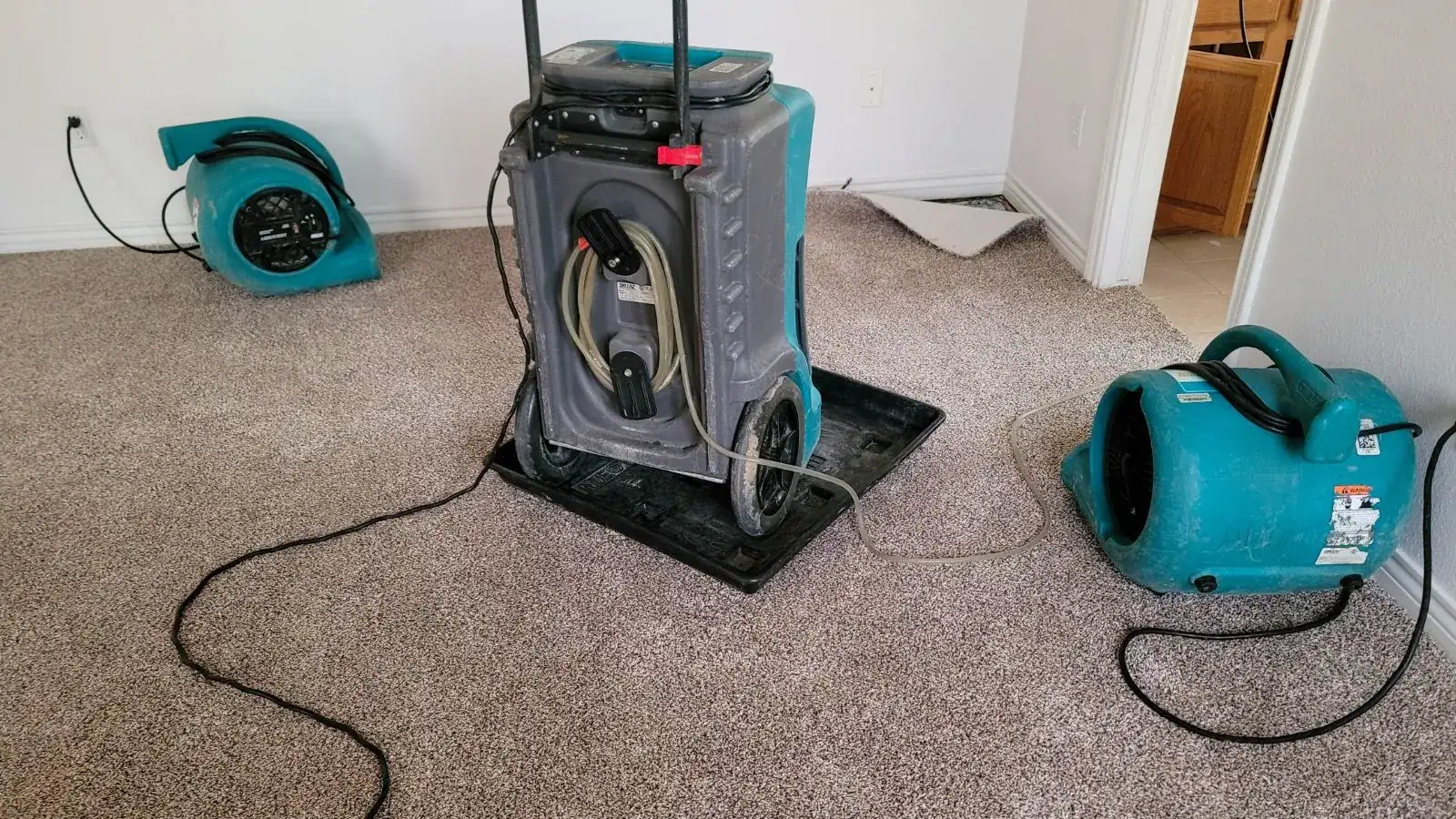
Drying is a measured job, not a waiting game
Once standing water is gone, the building still holds a lot of it. Framing, subfloor, drywall and insulation take on moisture slowly and release it slowly. Structural drying is the controlled phase that pulls that water out using airflow, warm air and dehumidifiers, while readings show whether it is working.
This page covers the drying phase only. The first days of stopping and removing water are described under water mitigation. If water is still on the floor, call (385) 988-9410 first and read this afterward.
What you notice and what drying does about it
| What you see | What it usually means | What happens next |
|---|---|---|
| Room feels damp and warm days after cleanup | Water is leaving materials as vapor and the air cannot hold more | Dehumidifiers run to take that vapor out of the air |
| Wall looks dry but paint is cool or soft | Moisture is still inside the cavity | Readings are taken at several heights and ports may be used |
| Floor feels firm but baseboards are swollen | Subfloor or framing is still holding water | Air is pushed under or through the floor system with mats |
| Musty smell in a closed room | Materials stayed wet and nothing is carrying moisture away | Containment, airflow and dehumidification start together |
Every house reads differently, so the plan follows your numbers and not a fixed schedule.
Safety steps while drying equipment runs
Drying equipment is simple, but it changes how a room behaves. These habits keep the process safe and the readings honest.
Do these in order
- Keep cords and hoses clear. Equipment cords cross floors and hallways, so keep children and pets out of the work area.
- Leave the equipment alone. Do not move, unplug or switch off air movers and dehumidifiers to save noise, because readings depend on steady operation.
- Keep doors and windows as set. Opening a window to help drying usually lets humid air back in and slows the room down.
- Watch for wet outlets. If a receptacle, switch or light fixture sat in water, leave it off until an electrician has checked it.
- Report new leaks at once. A fresh drip or a damp spot that spreads means the source is not fixed, so call (385) 988-9410.
Fix the source first
Drying cannot finish while water keeps arriving. A plumber, roofer or HVAC technician handles the leak itself, and we start or resume drying once it is stopped.
Climate and housing shape the drying plan
NOAA climate normals for 1991 to 2020 at nearby stations show about 20 inches of precipitation and 66 inches of snowfall a year at Spanish Fork Power House, and about 18 inches and 55 inches at Santaquin Chlorinator. Those are neighbor stations, not Payson readings, but they point to a region with real winter moisture and heating-season closed-up homes.
Census data says about 36 percent of Payson homes were built before 1980, so older framing and finishes turn up often. Repairs that follow drying may need a city permit depending on the work, and Payson's Building Division is the place to ask.
Source type: NOAA NCEI climate normals, U.S. Census Bureau American Community Survey and Payson City Development ServicesThe equipment and what each piece does
A drying setup is chosen from readings, room size and the materials involved.
Air movers
Low, fast fans that skim air across wet surfaces so water evaporates from them. They are placed along walls and across floors, not aimed at the middle of a room.
Refrigerant (LGR) dehumidifiers
They chill incoming air to condense vapor into water that drains away. They work well in warm, closed rooms with a lot of moisture to remove.
Desiccant dehumidifiers
They use a drying wheel instead of cold coils, so they keep working in cool rooms and garages. Winter jobs in unheated spaces often call for one.
Ports, mats and containment
Small ports let air into closed wall cavities, mats pull moisture from floors, and plastic sheeting holds the drying zone together so equipment does not dry the whole house.
Daily monitoring visits and the dry standard
On each visit, a technician records temperature, relative humidity and moisture content at the same marked spots. Air readings show whether dehumidifiers are keeping up. Material readings show whether wood, drywall and concrete are actually giving up water.
The target is a dry standard taken from similar unaffected materials in your own home, such as an interior wall that never got wet. A wet wall is dry when it reads close to that reference, not when it simply feels dry. Our process follows the published ANSI/IICRC S500 reference for water damage restoration.
Wet materials still in the house?
Call (385) 988-9410 and we will explain the drying plan before work starts.
Why dry outdoor air does not dry a closed room
A cold, dry day outside can still hold very little water. Warming that air indoors helps, but opening windows lets the room's humidity swing with the weather and gives no control over how fast materials dry. Even when outdoor air is dry, an unheated room stays cool, and cool materials release water slowly.
A closed, contained room with equipment lets the dehumidifier hold the air at a low, steady humidity so the wet materials keep releasing water. That is why windows stay shut while equipment runs.
Do it yourself or call
Household fans and a store-bought dehumidifier can help with a small, clean spill on a hard surface. They do not reach wet insulation, wall cavities or subfloor, and they cannot tell you when a structure is dry.
If water soaked carpet pad, drywall or flooring, or if anything sat wet for more than a day or two, call (385) 988-9410. We can read the structure, explain the plan and tell you plainly if drying is not the right step. Compare options on hardwood floor water damage if wood floors are involved.
What affects the cost of structural drying
Scope and price are explained before work starts. These factors move the plan more than anything else.
- How many rooms and how much square footage are wet
- Which materials hold the water, such as concrete, framing or hardwood
- How long the area sat wet before drying began
- How many pieces of equipment the readings call for and how many days they run
- Whether walls, floors or ceilings need ports, mats or containment
Insurance often responds differently to sudden events than to slow leaks, and flood damage is usually handled separately from plumbing failures. Photograph the damage, call your insurer early and keep your drying logs. We provide documentation of readings and equipment, but coverage decisions are the insurer's.
When equipment comes out, and what it does to your power bill
Equipment is pulled only after the final readings match the dry standard. Pulling it early is how damp framing ends up behind finished walls, so a short extra day usually costs less than a second job.
Dehumidifiers and air movers do add to electric use while they run. Ask for the number of units and running days at the start, so you know what to expect, and tell your insurer about the added power use.
Structural drying questions
Yes. Call (385) 988-9410, the 24/7 line, and describe what is wet. We explain the drying plan and when a technician will walk the space once the details are on the table.
It depends on materials, moisture level and conditions. Many jobs run several days, thick concrete or wood can take longer, and daily readings show when the structure is dry.
For a small clean spill, yes. For wet walls, subfloor or insulation, consumer units seldom remove enough, and without readings you cannot know when to stop.
Drying removes the moisture mold needs, but it does not clean existing growth. If growth shows, see mold remediation.
Readings change daily. Visits let us adjust fans and dehumidifiers and confirm progress before equipment comes out.
Drying service around Payson
We work from 39 N Professional Way in Payson and also serve Spanish Fork and Salem.
Homes in Santaquin and Springville get the same monitored approach. Call (385) 988-9410 and we will talk through what is wet.
Need readings you can trust?
Call (385) 988-9410 to talk through monitoring and what the numbers should show.