
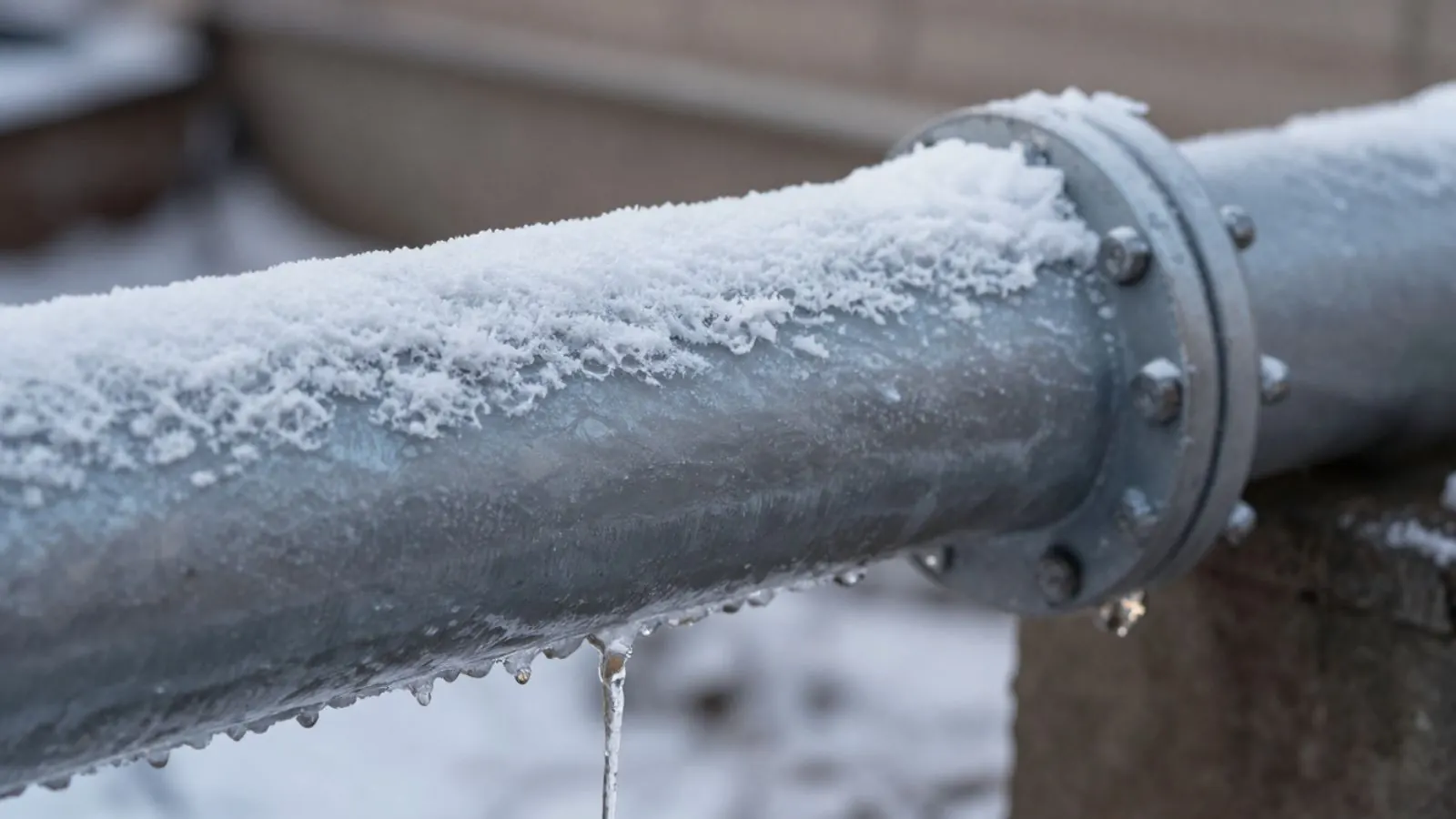
Why a frozen pipe floods after the cold breaks
Ice by itself rarely soaks a house. When water freezes inside a pipe it expands, and the pressure often splits the pipe wall or pops a joint. The split can sit closed and dry for days because the ice plugs it.
The flood starts when the temperature rises. The ice melts, the plug lets go, and a line under pressure pours into a wall, ceiling or floor. That makes a frozen pipe a delayed water loss. If water is already moving, our emergency water removal crew can start extracting while your plumber works on the pipe.
What a frozen pipe looks like before and after the thaw
| What you see | What it may mean | What happens next |
|---|---|---|
| A faucet gives a trickle or nothing in cold weather | Ice is blocking the line, and a split may be hiding behind it | Shut the main, open the tap, call a plumber and watch nearby walls |
| A stain or drip on a ceiling or wall after the weather warms | A thawed split is leaking inside the cavity | Water is shut off, then we map moisture in the cavity |
| A frosted or bulging pipe along an exterior wall | Ice has formed and the pipe is under strain | The plumber assesses the pipe, and we check the wall once water flows again |
Symptoms overlap, so a moisture reading is what confirms where the water went.
First-hour safety steps for a frozen or thawing pipe
Most of the damage is decided right after the pipe starts to thaw. Stop at any step that feels unsafe.
Do these in order
- Shut the main first. Close the main water valve before you try to thaw anything, so a hidden split cannot flow when the ice melts.
- Open a faucet. Open the tap closest to the frozen section so melting water and pressure have somewhere to go.
- Thaw gently. Use warm air from a hair dryer or simply heat the room. Never put a flame, torch or propane heater near a pipe.
- Look before you warm it. Check the pipe and the wall around it for bulges, cracks or damp spots. If you find any, stop and call a plumber.
- Call the right people. A plumber repairs or replaces the pipe. Call us at (385) 988-9410 once water has escaped into the structure.
No open flame on a pipe
A torch can ignite framing or insulation inside a wall and can overheat a pipe until it fails.
What Payson winters and Payson houses mean for pipes
NOAA climate normals for 1991 to 2020 show about 66 inches of snow a year at the Spanish Fork Power House station and about 55 inches at Santaquin Chlorinator. Those are neighboring stations, not Payson readings, but they point to a real snow season.
Census estimates for 2019 to 2023 say roughly 36 percent of Payson homes, or 2,528, were built before 1980, and older houses can have older supply lines. Payson City also runs a pressurized irrigation system with about 5,000 connections, separate from drinking water and running from roughly spring to fall.
Source type: NOAA NCEI climate normals, U.S. Census Bureau American Community Survey and the Payson City Public Works websiteThe places pipes freeze first
Pipes inside exterior walls sit between the warm room and the cold sheathing. Sink supply lines on an outside wall are the classic example. Garages are a second trouble spot, because a laundry hookup or utility sink there may feed from a line that never sees much heat.
Unheated crawl spaces and attic runs follow the same logic. A line lying over a vent opening or through bare attic space can freeze in a hard cold snap, and the split often shows later as a ceiling stain. Standing water under a house is covered on our crawl space water damage page.
Hose bibs and irrigation lines
A hose left attached through winter traps water in the spigot, and the freeze can crack the valve body inside the wall. You often learn about it in spring, when water sprays into the cavity. Disconnect hoses and drain outdoor spigots before the first hard freeze.
Irrigation lines are a separate system. The city's pressurized irrigation feeds yard sprinklers, not your kitchen tap, so a split there floods a yard, window well or foundation edge. Backflow assemblies and valves near the house still need draining.
Pipe thawed and water is moving?
Call (385) 988-9410 and tell us where the water is.
How we dry a home after a pipe thaws
Our process follows ANSI/IICRC S500, a published reference for water damage restoration work. It is a reference we work from, not a credential.
Extraction units and wet vacs
Portable extraction units and wet vacs lift standing water from floors and carpet before it soaks into the subfloor.
Moisture meters and thermal camera
Meters and a thermal camera show wet drywall, insulation and framing behind finished surfaces. That mapping tells us what to open and what to leave alone.
Air movers and injection drying
Air movers push dry air across wet surfaces. Drying mats or injection ports can draw moisture from wall cavities where conditions allow, which can limit tear-out.
LGR dehumidifiers
Low-grain refrigerant dehumidifiers pull moisture from the air so water leaving the materials has somewhere to go. We check readings each visit.
Thaw it yourself or call someone
Warming an exposed pipe with a hair dryer is reasonable when the pipe is easy to reach, the main is shut and nothing is leaking. It is not reasonable for a pipe inside a wall, a pipe that looks cracked, or any line you cannot see.
Repairing the pipe is plumber work, and we do not do it. Our part starts when water has escaped. If you see wet drywall or a damp floor, call (385) 988-9410. Our water mitigation page explains the stop-and-dry stage.
What affects the cost of frozen pipe water damage cleanup
Scope and price are explained before work starts. These factors move the job up or down.
- How long water ran after the thaw before the main was closed
- How many rooms and floor levels the water reached
- Whether water went into wall cavities, ceilings or insulation
- Which materials are wet, such as carpet, hardwood, drywall or plaster
- How many days of drying equipment and monitoring the structure needs
Insurers often treat a sudden pipe failure differently from slow seepage, and a freeze split is often the sudden kind. Flood policies generally address rising surface water, not plumbing. Photograph everything, call your insurer early and keep the plumber's invoice. We provide drying logs and photos, but coverage is your insurer's decision.
Prevention before winter arrives
A little fall work beats a wet wall in January.
- Disconnect hoses and drain outdoor spigots before the first hard freeze
- Find your main water shutoff and make sure it turns
- Insulate supply lines in the garage, crawl space, attic and exterior walls
- On very cold nights, open cabinet doors on outside walls and let a faucet drip
Frozen pipe damage questions
Yes. The line at (385) 988-9410 is answered 24/7. Tell us where the water is, which rooms are wet and whether the main is shut off, and we will explain the next steps. Your plumber still repairs the pipe.
Only if you can see and reach the pipe, the main is closed and there is no leak. Use warm air and an open faucet, never a flame. If the pipe is in a wall or looks cracked, call a plumber.
Ice can seal a split. When it melts, the seal goes and pressurized water flows out, often hours or days after the freeze.
Usually it is different. Irrigation lines feed the yard, so splits tend to flood landscaping, window wells or the foundation edge. If water reached a basement, we can extract and dry it, including for homes in Santaquin.
It depends on your policy and on how the loss happened. Many policies treat sudden pipe failure differently from gradual leaks. Call your insurer early and document everything.
Frozen pipe help across Utah County
We work from 39 N Professional Way in Payson and cover the town and nearby communities. Homeowners in Spanish Fork and Salem can call the same 24/7 line.
Santaquin and Springville are also in our service area. See Santaquin and Springville for local detail, or call (385) 988-9410.
Not sure the walls are dry?
Call (385) 988-9410 and we can talk through moisture mapping.