
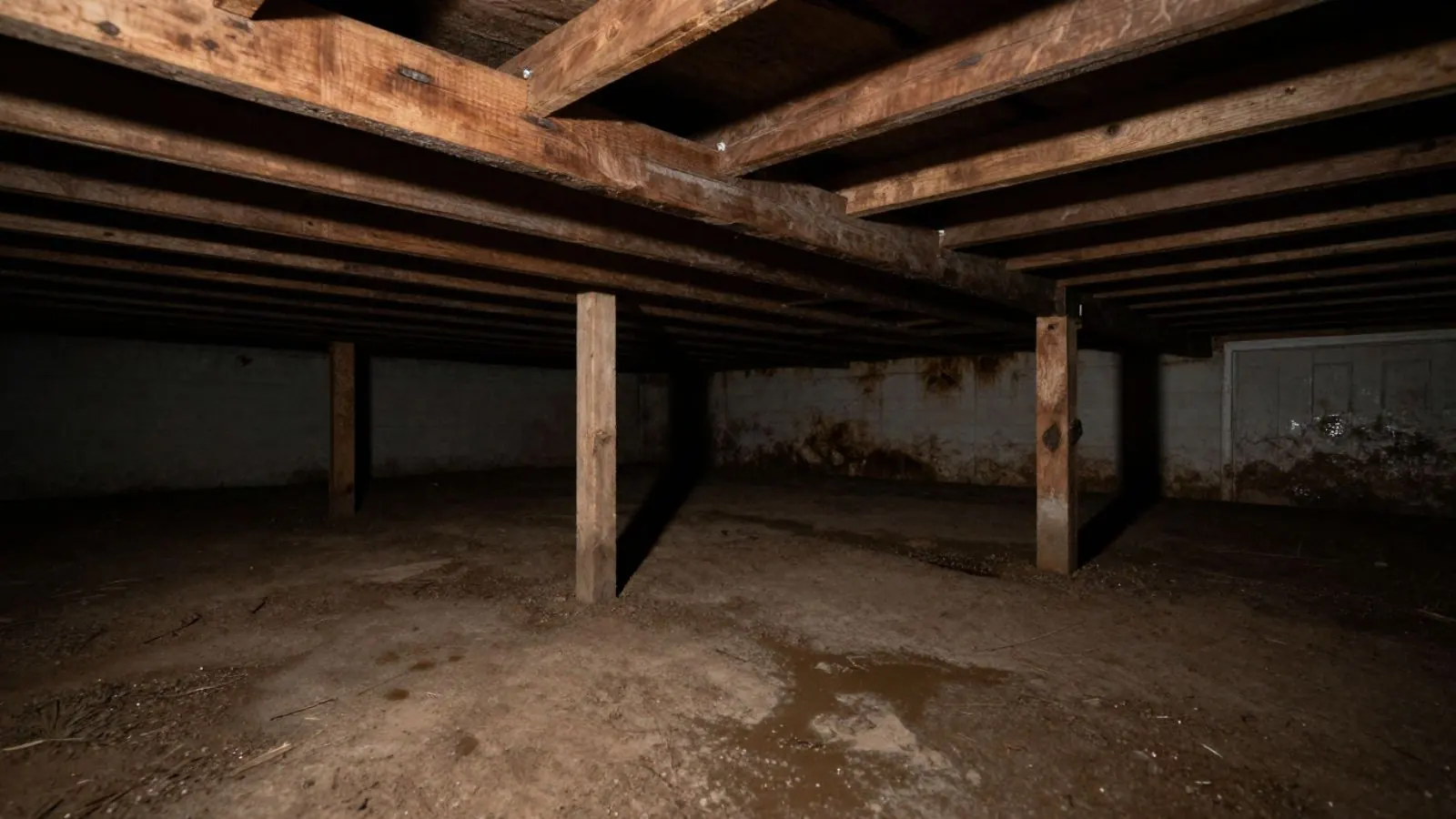
When the space under your floor takes on water
A crawl space is the shallow gap between the ground and the first floor of a house. Not every Payson home has one, since many are built over basements or on slabs, so this page matters only if yours does. When water gets in, it sits out of sight, soaks the joists and subfloor from below, and can go unnoticed until a floor feels soft or a musty smell drifts up through the vents.
The usual causes are runoff from a yard that slopes toward the foundation, an irrigation line or sprinkler head that leaks near the wall, a failed supply line under a bathroom or kitchen, and spring melt that saturates the soil. Each one leaves a slightly different pattern, and finding which one matters before drying starts.
What you notice and what it usually means
| What you see | What it often means | What happens next |
|---|---|---|
| Standing water or mud under the floor | Runoff, a high water table or a sprinkler leak outside | We pump it out, then check how far the moisture climbed |
| Insulation sagging or lying on the ground | Batts soaked from a leak above or water below | Wet batts are removed so the framing can dry |
| Floors feel soft or bouncy in one area | Subfloor or joists holding moisture | Moisture readings map the wet zone before drying equipment goes in |
| Damp smell and torn vapor barrier | Ground moisture is moving up unchecked | We dry the space, and you decide on repairs to the barrier |
Soil that stays wet after the water is gone keeps feeding moisture upward, so we read it again before we leave.
First-hour safety steps for water under your house
The space under a house combines water, wiring and tight quarters. Take it slowly and do not crawl in alone.
Do these in order
- Find the source. If a pipe is leaking, close the main water valve. If the water is coming from outside, note where the yard drains toward the house.
- Stay out of the opening. Crawl spaces are cramped, and a fall or a dropped light in standing water is a real danger. Look in from the access door with a flashlight.
- Treat wiring as live. Cables, junction boxes and sometimes ducting run through the joists. Do not step in water near any of them.
- Stop the irrigation. Turn off sprinklers on the zone nearest the foundation so more water is not added.
- Take photos. Shoot the water level, the insulation and any visible stains from the access point, then call our line.
If you see sparks or smell gas
Leave the area and call 911 or the utility first. Electrical problems under a house are for an electrician. We start work once the space is safe.
Why the timing of water matters here
Payson City Public Works runs a pressurized irrigation system with roughly 5,000 connections, separate from drinking water, and it operates from about spring to fall. Its supply draws on sources such as the Strawberry High Line Canal and flows from Payson Canyon. In irrigation season, a sprinkler line leaking beside a foundation can feed a crawl space for days.
The city's 2023 flood-preparation letter noted snowpack at the Payson Canyon SNOTEL site at 253 percent of normal in April 2023, with high water generally peaking from mid-May to mid-June. Census data shows about 36 percent of Payson homes were built before 1980, and older framing and foundations can let more moisture in.
Source type: Payson City Public Works website, Payson City 2023 flood-preparation letter with NRCS SNOTEL data, and U.S. Census Bureau American Community SurveyHow we dry a wet crawl space
Tight access shapes the job, so the equipment is chosen to fit through the opening.
Submersible pump and hose
A small submersible pump sits in the lowest spot and sends water out through a hose to a safe discharge point away from the foundation.
Protective gear
Crew members wear waterproof boots, gloves, knee protection and respirators suited to damp, dusty air, and work with headlamps because the space is dark.
Moisture meters
Meters read joists, subfloor and sill plates, and a thermal camera shows cool damp areas, so we know where drying has to focus.
Air movers and dehumidifiers
Air movers push dry air across the wood, and dehumidifiers remove moisture from the air so the framing can release what it holds. Readings are logged each visit.
Water under your floors?
Call (385) 988-9410 and describe what you see from the access door.
Do it yourself or call someone
A shallow puddle from a single event can often be handled with a wet vac, if the space is easy to reach and the wiring is clear. Deeper water, soaked insulation or a damp subfloor is a different job, because pumping is only the first stage and the wood has to be dried to a measured level.
We do not fix the source. A plumber repairs supply lines, a landscaper or drainage contractor corrects grading, and an electrician looks at wiring. We run the pump, dry the structure and document it, and our process follows ANSI/IICRC S500 as a published reference. For standing water elsewhere in the house, see emergency water removal.
What affects the cost of crawl space water damage
Scope and price are explained before work starts. These are the things that shape the job.
- How much standing water has to be pumped and how far it must be discharged
- How much insulation is wet and has to be removed
- The size of the space and how hard it is to reach
- How many joists and how much subfloor read wet
- How many days the drying equipment needs to run
Insurance often depends on whether the water was sudden, such as a burst supply line, or gradual, such as seepage over months. Groundwater and surface flooding are usually treated differently from plumbing failures. Photograph everything first, call your insurer early, and we provide documentation of readings and work. We cannot promise what a policy will cover.
Mold is a separate question
Damp wood and soil can support mold, and some crawl spaces have it already when we arrive. We dry the structure so conditions improve, but removal of mold growth is its own service. If you see growth or want it assessed, read about mold remediation. We also serve neighbors in Spanish Fork who face similar crawl space questions.
Mistakes to avoid
Closing the vents and hoping the space dries on its own usually traps humidity. Spreading a bag of lime or covering wet soil with plastic hides the problem and can keep the wood wet. Another common error is leaving soaked batts in place, because they hold water against the joists for weeks.
Do not run a sump pump from an extension cord laid through standing water. Call us and we will set it up safely.
Crawl space water questions
Yes. Our line at (385) 988-9410 is answered 24/7. Tell us what you see from the access door and we will explain the next steps.
No. Many homes have basements or slabs. If your house has a crawl space, we can inspect and dry it. If you have a basement, see our basement page instead.
No. A plumber repairs pipes and a drainage contractor corrects grading. We remove the water, dry the structure and document the loss.
We take moisture meter readings of joists and subfloor on each visit and compare them with unaffected wood. We stop when readings match.
Usually not for the whole time, though we need access to the crawl space door and to power. We will explain the schedule before equipment goes in.
Crawl space help around Payson
Our base is 39 N Professional Way in Payson, UT, and we answer the 24/7 line at (385) 988-9410. Homes differ in foundation type, so we look at yours before suggesting a plan.
We also serve Santaquin and Salem, along with Spanish Fork and Springville.
Get the space dried properly
Our crew is reachable at (385) 988-9410 around the clock.