
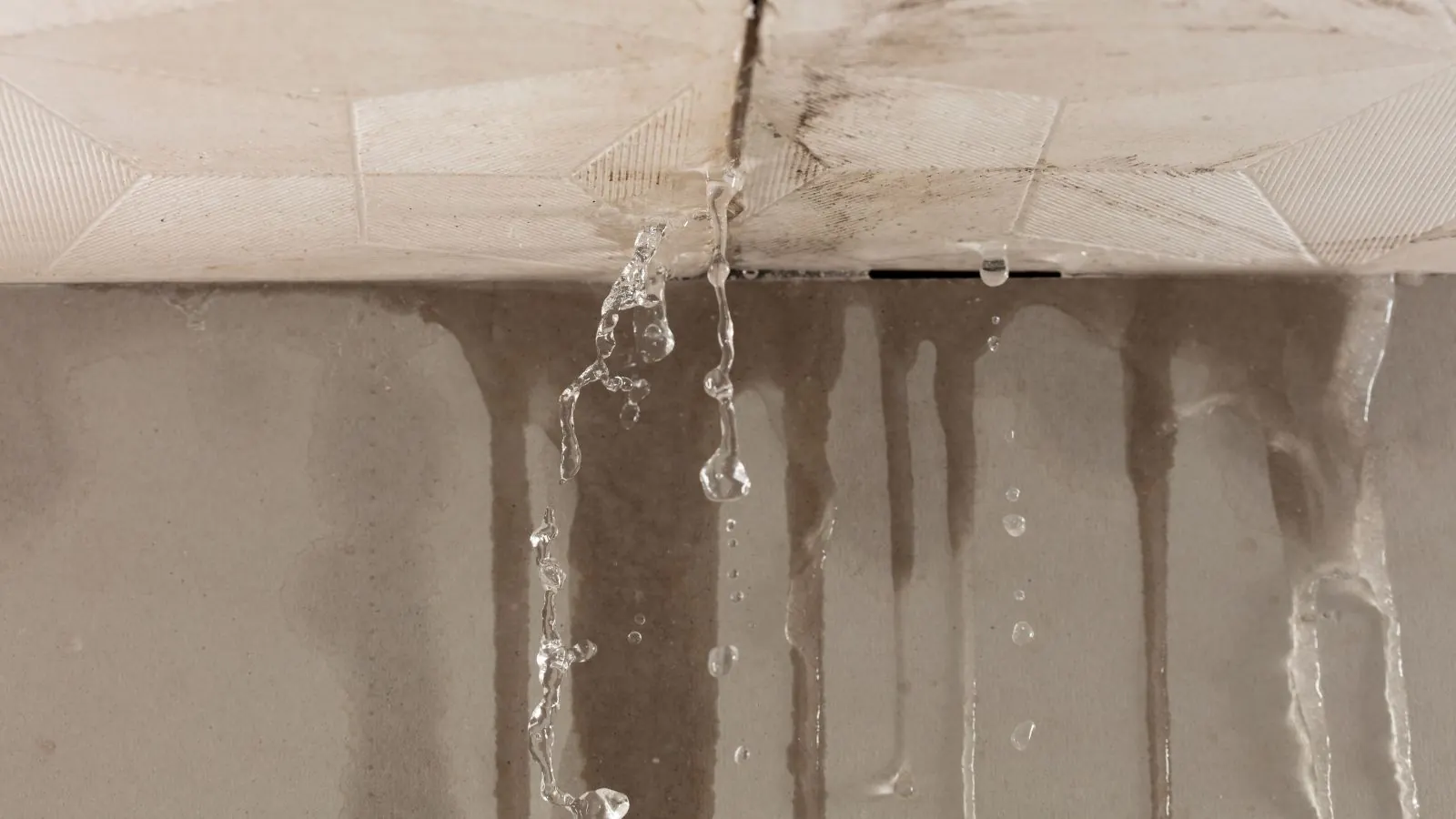
Where roof water really ends up
Water that gets under shingles does not drop straight down. It runs along the underlayment, down a rafter or across the top of the ceiling drywall, and it can travel several feet before it shows up. The stain you see on the ceiling is often well away from the actual opening.
Winter makes this worse. Heavy snow sits on the roof for weeks, and melt can creep back under the shingles whenever the surface freezes again. Wet attic insulation holds that water against the ceiling, so the damage keeps growing after the weather clears.
Ceiling and attic clues, and what they point to
| What you see | What it may mean | What happens next |
|---|---|---|
| A brown ring or stain on a ceiling | Water is sitting on or soaking through the drywall above it | We check the attic side, map moisture and find how far the wet area reaches |
| A sagging or bubbling ceiling | Drywall is holding a pocket of water | Safe release of the water, then removal of the soaked section |
| Damp or matted attic insulation | Roof water has been entering for a while | Wet insulation is removed and the framing is dried |
| Drips at a light fixture or vent | Water has found a path along wiring or ductwork | Power is kept off in that area and the cavity is opened and dried |
The stain marks where water arrived, not necessarily where it got in.
First-hour safety steps for a roof leak
A leaking roof is stressful, but the rule is simple. Keep people off the roof and protect what you can reach from inside.
Do these in order
- Stay off the roof. Never climb a snowy, icy or wet roof to look for the leak. Falls are the bigger danger here.
- Catch and contain. Put buckets under drips and move furniture, electronics and rugs out of the way. Poke a small hole in a bulging ceiling only if it is safe and you can drain it into a bucket.
- Watch the electrical. Water near a ceiling fixture or fan is a shock risk. Turn off that circuit at a dry panel and stay out of wet areas with live outlets.
- Photograph everything. Take wide and close photos of the ceiling, the attic if you can reach it from a ladder at the hatch, and any damaged belongings.
- Call a roofer. Stopping water from entering is a roofer's job, including any tarp. Ask them to note the interior damage as well.
- Call us for the inside. Once water has reached insulation, drywall or floors, call (385) 988-9410 and describe what you see.
Tarping is roof work
A tarp has to be fastened and sealed on a sloped surface, often in poor weather. That belongs to a roofer with the right gear, not to a homeowner on a ladder.
Snow, older homes and permits in Payson
NOAA climate normals for 1991 to 2020 show about 20.2 inches of precipitation and 66 inches of snowfall a year at the Spanish Fork Power House station. The Santaquin Chlorinator station shows about 18.4 inches and 55 inches. These are neighboring stations, not Payson readings, so treat them as a regional guide.
Census estimates for 2019 to 2023 put roughly 36 percent of Payson homes, or 2,528, before 1980, with a median build year of 1994. Roofs and attic insulation in older houses may be older too. If the repair involves structural work, ask the Building Division of Payson City Development Services whether a permit applies, since that depends on the work.
Source type: NOAA NCEI climate normals, U.S. Census Bureau American Community Survey and Payson City Development ServicesSnow load, ice dams and freeze-thaw
An ice dam forms when heat from the house melts snow on the upper roof, and the water refreezes at the cold eave. The ice ridge then holds back later melt, and that pooled water can push up under shingles and through the underlayment. Weak spots around flashing, chimneys and skylights are common entry points.
Repeated freezing and thawing also opens small gaps over time. A roof that looked fine in fall can leak after a stretch of storms. Fixing the cause means roof work, ventilation changes or added insulation, all of which a roofer or insulation contractor can advise on.
Water coming through the ceiling?
Call (385) 988-9410 and describe what you see.
How we handle the inside of a roof leak
Our process follows ANSI/IICRC S500, a published reference for water damage restoration. We use it as a reference, not as a credential.
Wet vacs and extraction units
Wet vacs and portable extraction units remove standing water and soaked material from floors, carpet and the lower levels that the ceiling water reached.
Moisture meters and thermal camera
A thermal camera shows cool, wet zones above and inside the ceiling. Moisture meters confirm what is wet in the drywall, framing and insulation.
Insulation and drywall removal
Wet insulation holds water against the ceiling, so we take it out in the affected area. Drywall that has lost its strength is cut back to dry material.
Air movers and dehumidifiers
Air movers and low-grain refrigerant dehumidifiers dry the framing and remaining surfaces. We check readings until the structure is back at a dry level.
Who does what after a roof leak
The roofer finds the entry point, repairs or replaces the damaged area and handles any tarp. We do not repair roofs and cannot tell you the roof is sound. Our work is water removal, insulation, drywall drying and moisture checks, which is the stage described on our water mitigation page.
Once the structure is dry, new drywall, paint and insulation are the rebuild stage, covered under water damage repair. Tell both the roofer and your insurer about the interior damage so each can document their part of the loss.
What affects the cost of roof leak water damage cleanup
Scope and price are explained before work starts. These are the usual drivers.
- How much attic insulation has to come out
- How far the water spread across the ceiling and walls
- Whether drywall can be dried in place or must be removed
- Whether the water reached floors, furniture or stored belongings
- How many days of drying equipment and monitoring are needed
Insurers often look at whether a roof loss was sudden, such as storm damage, or gradual, such as long-term wear. Document the interior damage, call your insurer early and keep the roofer's report. We provide moisture readings and photos to support the claim, but coverage decisions are the insurer's.
Mistakes to avoid after a roof leak
These choices make a small problem bigger.
- Climbing onto a wet or snowy roof to check it
- Leaving soaked insulation in the attic because the stain looks small
- Painting over a ceiling stain before the framing above is dry
- Waiting to call the roofer or insurer until the next storm
- Assuming a dry-looking ceiling means the attic is dry too
Roof leak damage questions
Yes. The line at (385) 988-9410 is answered 24/7. Tell us where you see water and what the ceiling looks like, and we will explain what to do next. A roofer handles the roof itself.
No. Roof repair and tarping belong to a roofer. We dry and clean the inside, including water removal, wet insulation and drywall.
Water follows rafters, underlayment and the top of the drywall before it drops. The visible stain can sit several feet from the entry point. An attic check and moisture readings show how far it traveled.
Often, yes. Wet insulation holds water against the ceiling and dries slowly. We assess the area and remove what is soaked, including for homes in Salem.
It depends on the policy and on the cause of the leak. Call your insurer early, share the roofer's findings and our documentation, and ask what they require.
Roof leak help near Payson
We work from 39 N Professional Way in Payson and cover the surrounding towns. Homes in Spanish Fork and Springville can reach the same 24/7 line.
Santaquin and Salem are also in our service area. Call (385) 988-9410 and tell us what the ceiling or attic looks like.
Roof fixed but the ceiling is still damp?
Call (385) 988-9410 and we will check the attic and drywall.