
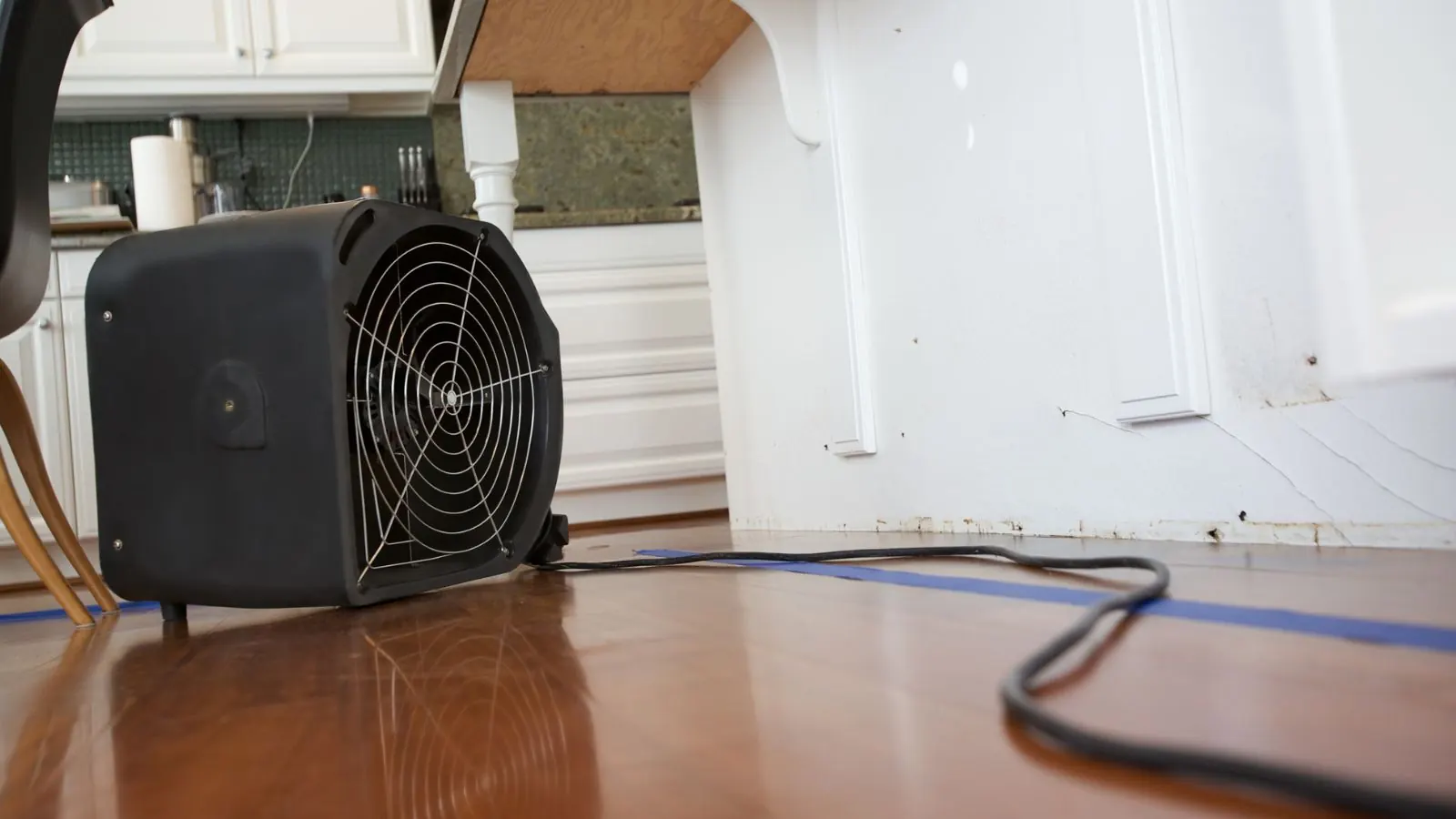
Why kitchen water spreads where you cannot see it
A kitchen packs plumbing, cabinets, flooring and appliances into one tight space. When the sink supply line or the drain trap lets go, the water drops straight into a cabinet box that is closed on three sides and sits on a base. It stays there, soaking the particleboard and the floor under it.
The visible part is often small. A wet cabinet floor or a darkened toe kick may be all you see, while the drywall behind the cabinets and the insulation in the wall are holding far more water than the surface suggests.
What you notice and what we look at
| What you see | What may be happening | What we do about it |
|---|---|---|
| Swollen cabinet floor under the sink | Drain or supply leak has soaked the particleboard base | Check the board with a meter, then decide on drying or replacement |
| Dark toe kick or lifting cabinet trim | Water has moved along the floor behind the cabinet run | Remove the toe kick and measure the wall base and subfloor |
| Cracked or hollow-sounding floor tile | Moisture is in the underlayment below the tile | Map the wet area and find out how far it runs under the floor |
Hollow sounds and soft spots mean we need to look under the surface before deciding anything.
First-hour safety steps for a kitchen leak
Stop the water source, keep power away from the wet area, and protect what you can reach.
Do these in order
- Close the angle stop under the sink. Each faucet and dishwasher line usually has its own small valve. Turn it clockwise. If it will not close, shut the main.
- Keep power off near water. Disposals, dishwashers and outlets on the backsplash are all risks. Switch off the breaker if water is near any of them.
- Empty the cabinet. Take out cleaning products, pots and paper goods so you can see where the water is. Do not stack wet items on dry surfaces.
- Do not run the dishwasher. If the leak may be from the dishwasher connection, running it again can add water to the same spot.
- Photograph the source and the damage. Capture the failed part, the wet cabinet and the floor before you wipe anything dry.
Gas stoves and wet floors
If you smell gas, leave the home and call the gas utility from outside. Do not turn on lights or appliances. Water cleanup can wait until the gas issue is handled.
Cabinets, toe kicks and countertops
Cabinet bases are the first thing water finds. Solid wood boxes can dry and stay serviceable. Particleboard and medium-density fiberboard swell and lose strength once they stay wet, and they rarely return to shape.
Countertops and backsplashes are rarely the wet part, but their seams matter. Water behind a tile backsplash can sit against the drywall for a long time. We check the wall behind the counter run with a meter before saying whether the backsplash can stay.
Older and newer kitchens in Payson homes
Census data from the American Community Survey shows about 36 percent of Payson homes, or 2,528, were built before 1980. Houses from that period may have older plumbing, different floor layers and cabinet construction that predates current norms. Newer homes tend to use particleboard cabinets and floating floors.
Culinary drinking water in town comes from Payson City Public Works, which reports about 6,700 connections. Permit questions for repair work go to the Building Division of the city's Development Services Department. Whether a given job needs a permit depends on the work, so ask them directly before you start cabinet or drywall replacement.
Source type: U.S. Census Bureau American Community Survey, Payson City Public Works website and Payson City Development ServicesLayered floors: tile, underlayment and hardwood
Tile sits on grout, thinset and often a cement board or plywood underlayment. Water can pass through grout joints and stay in the layers below, and the tile itself looks undamaged. If you also have wood in the kitchen, our hardwood floor water damage page covers cupping and what can be saved.
Vinyl plank and laminate float over a pad. Water can run beneath them and spread across the room. A thermal camera and a meter show where the pad is wet, and sometimes a few planks need lifting so the subfloor can dry.
Water under the sink?
Close the valve, then call (385) 988-9410 and describe the cabinet and floor.
Drying cabinets in place or taking them out
The choice depends on the cabinet material, how long it stayed wet, and what the readings show behind it.
Drilling small ports
For solid cabinets that are still dry on top, we can drill small ports in the toe kick. Warm air is pushed into the cavity. The ports are patched afterward.
Pulling the toe kick
Removing the toe kick exposes the cabinet base and wall bottom. It is a small, reversible step and tells us a lot about how far the water went.
Removing a cabinet run
When the base is swollen or the wall behind is wet, taking out a section can be the better choice. It lets us dry the wall and floor completely.
Dehumidifiers and air movers
Air movers push dry air across the floor and into open cavities. Dehumidifiers hold the room's humidity down so the materials give up water. Readings are logged each visit.
Doing it yourself or calling in help
A quickly caught leak with a dry cabinet floor can often be handled with towels and a fan. If the cabinet bottom feels spongy or the leak ran overnight, the water has probably gone further.
Our process follows the published ANSI/IICRC S500 reference for water damage. We explain what we plan to remove, and what we can dry in place. For the rebuild that follows, our water damage repair page covers drywall, cabinets and flooring.
What affects the cost of kitchen water damage work
Scope and price are explained before work starts. These factors move the scope the most:
- Whether the water stayed in the cabinet or reached the floor and walls
- Cabinet material and whether it can be dried or must be replaced
- The flooring type and how many layers it has
- Whether insulation and drywall behind the cabinets are wet
- How many days of drying the readings call for
Insurers usually treat a sudden pipe or hose failure differently from a seep that ran for months. Policies vary, so call early and keep the failed part. We provide moisture readings and a written scope for your adjuster. We cannot say what a policy will cover.
Small checks that save a kitchen
Look under the sink monthly with a flashlight and run a dry paper towel along the supply connections. Replace old supply lines before they fail.
Replace old supply lines before they fail, and keep the dishwasher connection accessible. If a leak does happen, a call to our appliance leak team helps when the source is a machine rather than the sink.
Kitchen water damage questions
Yes. Our line at (385) 988-9410 is answered 24/7, including nights and weekends. Tell us where the water is coming from and whether it is shut off, and we will walk you through what to do next.
Sometimes. Solid wood boxes often dry out and stay usable. Particleboard that has swelled usually does not recover. Readings and a close look at the cabinet base tell us which case you have.
Water can sit in the underlayment below tile with no visible sign. We map the wet area with a meter and camera, and we dry it with air movement and dehumidification before any decision on replacement.
It depends on the work. Payson City's Building Division, part of Development Services, can tell you whether your cabinet or drywall work needs one. Ask them before you start.
It depends on your policy and whether the leak was sudden or slow. Report it early and take photos. We provide documentation, but the insurer makes the coverage decision.
Kitchen water damage across the Payson area
Our office is at 39 N Professional Way in Payson. We serve kitchens in town and in nearby communities, including Spanish Fork and Salem.
Homes in Santaquin and Springville are also within our service area. Call (385) 988-9410 and we will talk through your address.
Cabinet base feels soft?
Call (385) 988-9410 and we will talk through whether drying in place is realistic.