
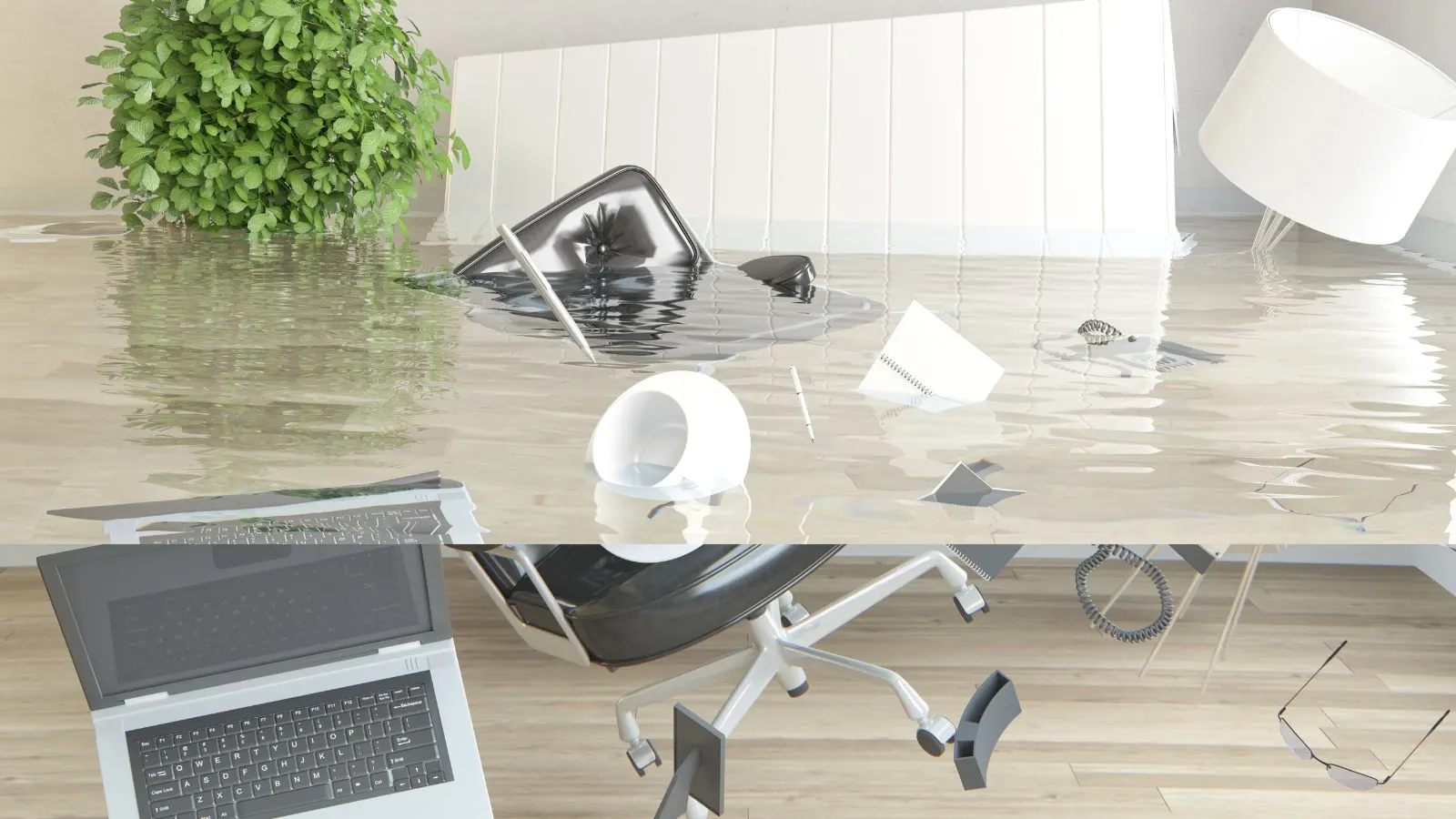
Water in a business space is a different kind of problem
A flooded office floor or storage area involves more people than a house does. There may be an owner, a tenant, a property manager and an insurer, each with questions about what happens next. The water itself behaves the same, so the first job is still to stop it, remove it and dry what it touched.
We handle the water side of the loss. That means extraction, moisture mapping, structural drying, cleanup, sanitizing, contents handling and written documentation. Other trades handle the building systems, and we say so when a repair is outside our work.
What you see and what it means for the space
| What you see | What it usually means | What happens next |
|---|---|---|
| Standing water on a floor | Water is moving into the slab joints, wall bases and anything on the floor | Extraction units and pumps remove it, then readings map the spread |
| Stained or sagging ceiling tiles | Water is above the ceiling and may be inside insulation | The source is stopped first, then wet materials are opened and dried |
| Damp walls with no visible puddle | Water has wicked into drywall and cavities | Moisture mapping marks the wet area and a drying plan follows |
| Wet boxes, stock or equipment | Contents are absorbing water and may be losing value fast | Items are moved, sorted and listed for the insurer |
Larger spaces vary a lot, so a scope visit confirms what the first phone call suggests.
First-hour safety steps for a flooded business space
Protect people first and property second. These steps fit most commercial water events.
Do these in order
- Clear the area. Move staff and visitors out of wet zones and keep them away from standing water.
- Stop the source if you can. Close the nearest fixture valve or the main shutoff. Know where the building shutoff is before you need it.
- Treat electrical areas as live. Do not step into water near panels, outlets or equipment. Have an electrician check anything that was wet.
- Lift valuables and records. Move papers, devices and stock onto shelves or tables if the move is safe.
- Photograph the damage. Wide and close shots of the water line, source and affected items help every later conversation.
- Call the 24/7 line. Phone (385) 988-9410 and describe the space and the source.
Fire and sprinkler lines
If a sprinkler head or fire system pipe is leaking, a fire protection contractor repairs it. We do not work on fire systems. Call them first, then call us for the water.
Payson city systems and what they mean for your building
Payson City Public Works supplies culinary water to about 6,700 connections and runs a sewer system of about 6,300 connections. Knowing which line your leak came from helps decide who to call, since the city handles mains and the property owner handles lines on the property.
Regional weather matters too. NOAA normals from neighboring Spanish Fork and Santaquin stations show roughly 18 to 20 inches of precipitation a year, and snow in winter, which is background to roof and drain issues rather than a Payson reading. Whether repairs need a permit depends on the work, and Payson's Development Services Building Division can answer that.
Source type: Payson City Public Works website, NOAA NCEI climate normals and Payson City Development ServicesWhat to tell us on the first call
The more specific the description, the better the first plan. Tell us what type of space it is, such as an office suite, a shop or a storage unit. Give the approximate area that is wet, the source if you know it, and whether the water is clean, from a drain or from outside.
Also say whether the shutoff has been closed, whether any power is out, and whether other units share the wall or floor. Those details help us bring the right extraction and drying equipment on the first visit.
Water in your building right now?
Call (385) 988-9410 and describe the space and the source.
How the work is done
The same core steps apply to most commercial losses, scaled to the space.
Extraction
Extraction units and submersible pumps pull standing water from floors and low spots. See emergency water removal for that stage.
Moisture mapping
Meters and a thermal camera trace water through walls, floors and ceilings, and the readings are recorded on a simple map of the space.
Drying
Air movers and dehumidifiers dry the structure, with daily readings. The details are in structural drying and dehumidification.
Cleanup and sanitizing
Surfaces are cleaned and treated with antimicrobial products where the water type calls for it, and wet materials that cannot be saved are removed.
Landlords, tenants and the insurance conversation
In a shared building, the lease usually decides who handles what, and that is between the parties. We can coordinate access with a landlord or tenant, share what we found and document each area separately so the paperwork is clear.
Business-interruption questions, such as lost income while a space is closed, are conversations with your insurer. We do not set or promise those terms, but our photos, readings and equipment logs give the adjuster something concrete to review.
When a scope visit comes first
A small leak in one room can often be planned from a phone call. A larger space, several rooms, or water that crossed a shared wall needs a visit before anyone commits to a plan. We walk the area, read the materials and explain what we found, following the published ANSI/IICRC S500 reference for water damage restoration.
Scope and price are explained before work starts, so the people responsible for the building can decide with the facts in front of them.
What affects the cost of commercial water damage work
Every building is different, but these factors shape the size of the job.
- Square footage and number of rooms affected
- Type of water and whether it carried contamination
- Flooring and wall materials, since carpet, tile and concrete dry differently
- Amount of contents that must be moved, sorted or cleaned
- Days of drying and how much equipment the readings call for
Commercial policies differ, so ask the insurer what applies to sudden leaks, gradual damage and flood. Document first, call early and keep every record. We provide documentation, and the coverage decision stays with the insurer.
Commercial water damage questions
Call (385) 988-9410, our 24/7 line. Tell us the type of space, the wet area, the source and whether the shutoff is closed, and we will explain the next step.
No. A plumber fixes pipes and a fire protection contractor fixes sprinkler systems. We handle the water removal, drying and cleanup.
Yes. We can coordinate access, share findings and document areas separately. Lease questions stay between the parties.
We can move, sort and clean affected items and create a list for your insurer. Some items may not be worth saving.
For larger spaces or water that spread across several rooms, yes. A visit lets us confirm the plan before work starts.
Commercial service around Payson
We are based at 39 N Professional Way in Payson and also serve businesses in Spanish Fork and Springville.
Spaces in Salem and Santaquin can call the same number. Dial (385) 988-9410 and describe the space.
Need documentation for an insurer?
Call (385) 988-9410 and ask how we record readings, photos and equipment.