
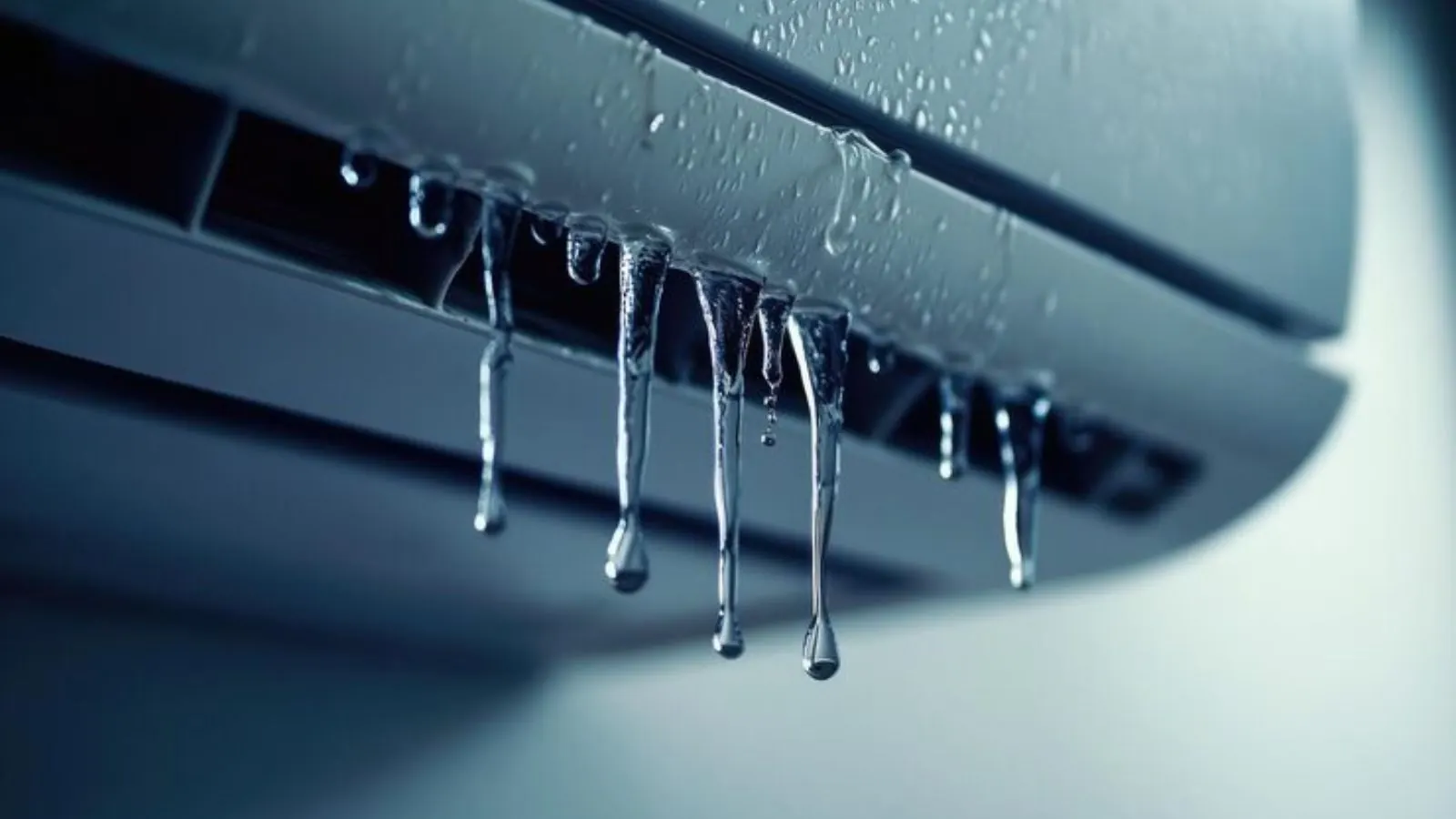
Most AC leaks are small, but they can go unnoticed
An air conditioner that leaks is almost never a flood. The usual picture is a slow drip or seep that wets a closet floor, a section of ceiling drywall or the insulation around the unit. The risk is not volume. It is that nobody sees it for weeks.
That is why a small AC leak can still need real drying. Wet drywall, baseboard and subfloor stay damp long after the surface looks fine, and a drip you ignore in July can leave a stained ceiling or soft floor by September.
What an AC leak looks like, and what to do about it
| What you see | What it may mean | What happens next |
|---|---|---|
| Water in the pan or on the floor beside the air handler | The condensate drain line is clogged or the pan has overflowed | HVAC tech clears the line, and we dry any wet floor or wall |
| A ceiling stain below an attic unit | The pan or drain line has leaked into the drywall | We map moisture, remove soaked material and dry the cavity |
| Ice on the coil, then water when it melts | The evaporative coil froze and is now thawing | HVAC tech finds why it froze, and we dry what the meltwater reached |
| A wet spot near a swamp cooler or its water line | A supply line, float or pad is leaking | The cooler is shut off and repaired, and we dry the area |
The cause is an HVAC repair. Drying is what we add.
First-hour safety steps for an AC leak
These steps limit the water and keep the electrical risk down. Stop at any step that feels unsafe.
Do these in order
- Turn the unit off. Switch the system off at the thermostat, and at the breaker if you can reach it without stepping in water. A running unit keeps making condensation.
- Stay clear of wet electrical. Air handlers have wiring and controls. Do not touch the unit or nearby outlets if there is standing water around them.
- Stop the water supply. If the leak is from an evaporative cooler, close its water supply valve.
- Soak up what you can. Use towels or a wet vac for the pan overflow and move stored items off the floor.
- Photograph the area. Take photos of the unit, the pan and any stains before cleanup.
- Call the right trades. An HVAC technician fixes the leak. Call (385) 988-9410 if drywall, insulation or flooring got wet.
Do not run a leaking unit
A unit that keeps cycling can keep adding water to a pan that is already full or a drain that is blocked. Leave it off until the HVAC technician has looked at it.
What the local numbers say about AC water
NOAA climate normals for 1991 to 2020 show about 20.2 inches of precipitation a year at the Spanish Fork Power House station and about 18.4 inches at Santaquin Chlorinator. Those are neighboring stations, not Payson readings. They are a reminder that water around an indoor AC unit comes from condensation inside the system, not from weather outside.
Census estimates for 2019 to 2023 say roughly 36 percent of Payson homes, or 2,528, were built before 1980, and the median build year is 1994. Cooling equipment, closets and attic layouts differ widely across that range. Payson City also supplies drinking water to about 6,700 connections, and an evaporative cooler uses that same household supply. We cannot say how many homes use which kind of cooling.
Source type: NOAA NCEI climate normals, U.S. Census Bureau American Community Survey and the Payson City Public Works websiteWhere the water comes from
Cooling a house pulls moisture out of the air, and that water has to leave through the condensate drain line. Algae and debris can clog the line, and the water then backs up into the pan under the air handler. If the pan overflows or cracks, it drips onto whatever is below.
Frozen evaporator coils are another source. Poor airflow or a refrigerant problem can ice the coil, and when the unit shuts off the ice melts faster than the pan can handle. Air handlers in closets, attics and utility rooms are especially likely to wet drywall, since a drip there lands on finished material.
AC leak and wet drywall or floor?
Call (385) 988-9410 and tell us where the water went.
Evaporative coolers work differently
Some homes use an evaporative cooler, often called a swamp cooler, instead of or alongside refrigerated air. These units are fed by a water supply line and use a float, pump and wet pads. A stuck float, a split line or a rusted pan can leak onto a roof, a wall or a floor.
The repair belongs to an HVAC technician or plumber. Water damage from the line often shows at the wall or ceiling near the unit. We dry the structure once the supply is shut and the leak is addressed.
How we dry after an AC leak
Our process follows ANSI/IICRC S500, a published reference for water damage restoration. It is a reference we use, not a credential.
Wet vacs and extraction
Wet vacs pull standing water from closet floors, pans and carpet before it wicks further into baseboard and subfloor.
Moisture meters and thermal camera
Meters and a thermal camera show how far a slow leak has spread through drywall, insulation and flooring.
Targeted material removal
Soaked insulation and weakened drywall are cut back to dry material. We keep the removal as small as the readings allow.
Air movers and dehumidifiers
Air movers and low-grain refrigerant dehumidifiers dry the remaining materials. Readings are checked until they reach a dry level.
Fix it yourself or call someone
Clearing a clogged condensate line is something some homeowners do, but it is HVAC maintenance, and an HVAC technician can also find the reason it clogged. Mopping up a small pan overflow is fine. Anything wet inside a wall, ceiling or subfloor needs a moisture check.
If the leak was small and quickly dried, you may need nothing more. When it sat for days, our water damage cleanup page explains how we handle the wet materials, and the rebuild is described under water damage repair.
What affects the cost of AC leak water damage repair
Scope and price are explained before work starts. Most AC jobs are small, but these factors set the size.
- How long the leak ran before it was found
- Whether the water reached drywall, insulation or only the floor
- How much material can be dried in place rather than removed
- The location of the unit, such as a closet, attic or utility room
- How many days of drying equipment and monitoring are needed
Insurers often treat sudden, accidental water differently from gradual seepage, and many AC leaks are slow. Document the damage, check your policy for exclusions and call your insurer early. We provide moisture readings and photos, but we cannot promise coverage.
AC leak water damage questions
Yes. The line at (385) 988-9410 is answered 24/7. Tell us where the water is and what is wet, and we will explain what to do. An HVAC technician fixes the unit itself.
Yes, though it is usually slow. A pan or drain line above a ceiling can drip for weeks before a stain shows. By then the drywall and insulation may be wet.
Common causes are a clogged condensate drain line, a full or cracked pan, or a frozen coil that melts. An HVAC technician can tell which applies to your system.
They use a water supply line, a float and pads, so leaks come from those parts. Shut the supply, have the unit repaired and then check the nearby walls and roof surfaces for dampness.
Yes. We cover homes in Springville and the other towns listed below.
AC leak help across the area
We work from 39 N Professional Way in Payson. Homeowners in Spanish Fork and Salem can call the same 24/7 line.
Santaquin and Springville are also in our service area. Call (385) 988-9410 and describe where the unit sits and what is wet.
Unit fixed but still damp?
Call (385) 988-9410 and we can check moisture levels.